

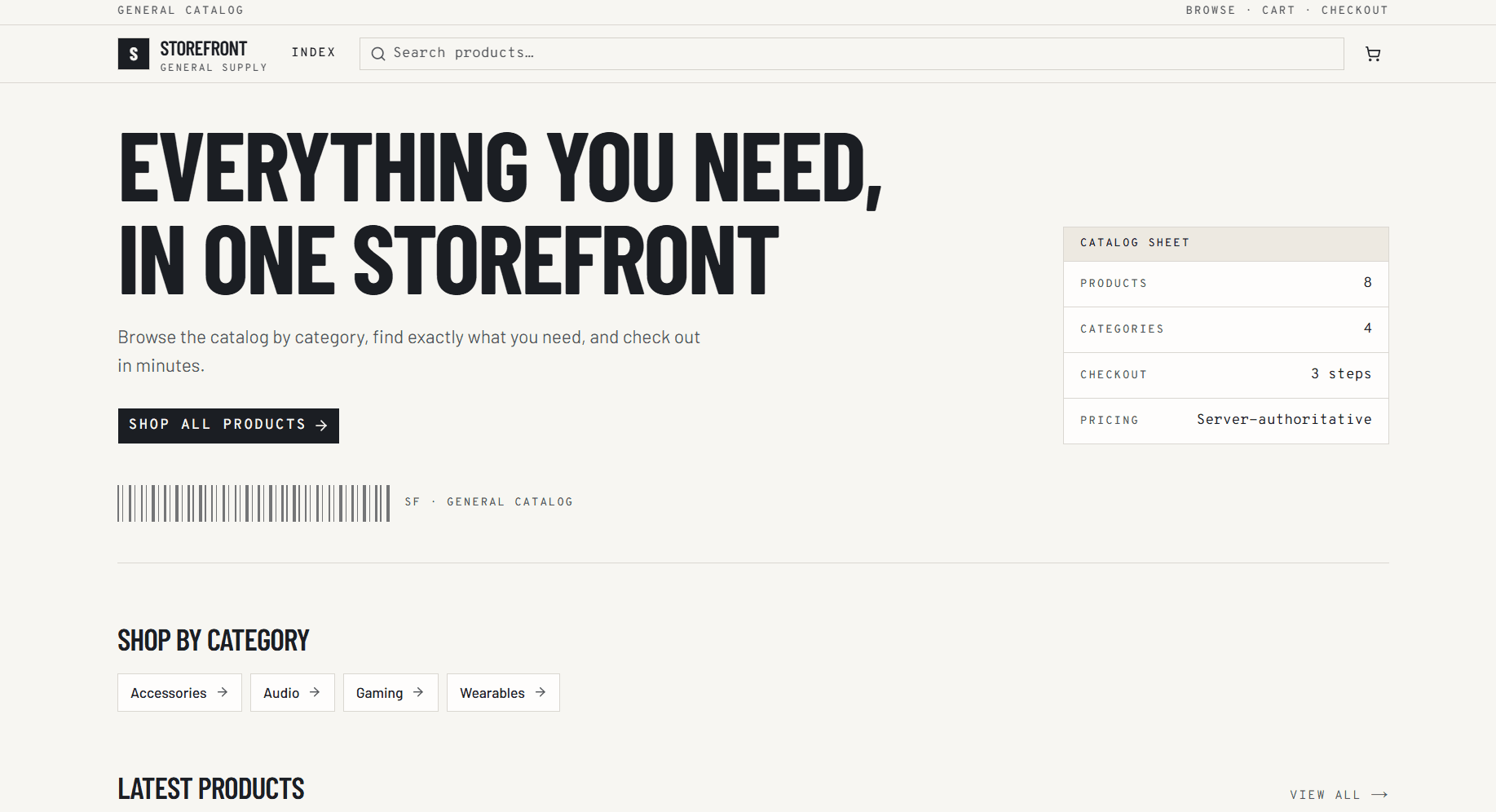
A live clothing store you can browse, buy from, and operate — not a template with dead buttons.
Browse products with URL-persisted search, pick the exact size and color that is in stock, merge quantities in the cart, and check out in three steps while prices stay frozen server-side. Store staff get a real console alongside it.
Overview
This is the frontend half of a full-stack commerce platform. The backend — Custom Ecommerce Backend API — owns every business rule, 24 PostgreSQL tables, and 71 REST endpoints under /api/v1. This Next.js application is both the customer storefront and the operations console that drives it.
Everything on screen is backed by a real endpoint. Empty states, loading skeletons, 403s, 409s, and 429s are designed screens, not afterthoughts.
The Problem
A commerce frontend usually stops at the happy path — a product grid and a cart that never fails. Operating a store is harder:
- One product has many purchasable variants (black / medium, blue / large) with separate SKUs, prices, stock, and images.
- Cart, discounts, shipping, stock reservation, and order snapshots must be server-authoritative — the client cannot trust its own math.
- Store staff need daily rigor: edit catalog, adjust stock without overselling, advance orders through only legal transitions, and prove who did what in an audit trail.
- Session and CSRF security must work without ever exposing a credential to JavaScript.
The Solution
A Next.js App Router application that treats the API contract as law and surfaces it completely:
- Same-origin by design —
next.config.tsrewrites/api/v1/:path*toAPI_ORIGIN, so thehttpOnly/SameSite=Laxsession cookie stays first-party — no token in JavaScript, no CORS. - CSRF wired once — a shared Axios instance (
withCredentials: true) fetches acsrf_tokenand attachesx-csrf-tokento every mutating request. No component touchesaxiosdirectly. - Server state discipline — TanStack Query caches keyed by full query params via a central
queryKeysfactory; Zustand is reserved for pure UI state (drawers/toasts).
Same-origin, same behavior locally and in production
Locally npm run dev on 3001 proxies to localhost:3000; in production Vercel rewrites to Render. The browser only ever talks to one origin.
Key Features
- Catalog that respects URLs — home, listing, and category pages with search, brand filter, sort, and pagination persisted in query params.
- Product detail that tells the truth — gallery, variant picker (color/size) with live availability and computed
final_price, ordered images withis_primary. - Cart that merges — merge-on-add quantities, live server-side pricing, update/remove/clear — backed by advisory-locked endpoints.
- Three-step checkout →
POST /orders— select saved address, optional coupon, shipping settles automatically, single-transaction order with immutable snapshots. - Orders & reviews — history with status timeline, detail with frozen prices; one review per user per product with direct-to-ImageKit image uploads.
- Account center — profile, password, email (emailed verification), phone (OTP), address book with per-type defaults, session devices (revoke one / revoke others), deletion.
- Admin console (
/admin, probe-gated) — dashboard KPIs + super-admin P&L/coupon analytics, products/variants/images editor (signed ImageKit uploads), categories, inventory reserve/release, order queue with a legal transition matrix, customers, coupons, and an append-only audit trail.
User Experience
Customer: browse → product detail (pick variant) → cart (merge) → 3-step checkout → order history with timeline → review with images → account.
Admin: dashboard → products editor (create variant, ImageKit upload) → categories / inventory → order queue (advance only legal transitions) → customers / coupons / audit.
Architecture at a Glance
One rule: no component talks to the network directly except through the shared client.
- Interface — App Router route groups
(storefront)/(auth)/admin, shadcn/ui v4, Tailwind v4 CSS-first theme. - Client —
features/<domain>/api.ts + hooks.ts + components/,lib/api/client.tsenvelope unwrapping (Paginated<T>),lib/api/queryKeys.tsfactory,<Money>for decimal strings,react-hook-form+ Zod mirroring server validation. - Platform — Vercel (storefront) → Render (API) → Neon (PostgreSQL);
next.config.tsremotePatterns forik.imagekit.io, security headers; probe-based admin detection (GET /admin/products200 vs 403).
See Design Docs above once available — for now
FRONTEND_PROMPT.md(§9–12) andtasks/index.md(T00–T30) are the authoritative specs alongside the backend's Architecture docs.
Tech Stack
| Tech | Role |
|---|---|
| Next.js 16 (App Router) + React 19 + TypeScript strict | File routes, server components, strict types |
| TanStack Query v5 | Server-state fetching, caching, invalidation |
| Axios + Zustand 5 | Shared CSRF-aware client; UI state only |
| Tailwind CSS v4 + shadcn/ui + lucide-react + vaul + recharts | Styling, primitives, icons, charts |
| react-hook-form + Zod | Forms — schemas mirroring server constraints |
| ImageKit + next/image | CDN images (avif/webp), signed direct uploads |
What This Project Shows
Product sense — turns a full platform into real screens: not just a product grid, but an operations console with transition-matrix order flow, guarded inventory adjustments, coupon P&L, and an audit trail that proves who did what. Every empty, loading, and error state is designed.
Engineering care — same-origin session architecture with zero tokens in JavaScript, one CSRF-aware Axios layer, typed paginated envelopes (Paginated<T>), URL-persisted browsing state, and probe-based role detection with server re-enforcement.
Dive deeper
Open Design Docs above for the full picture: Architecture, Functional Requirements, and Architecture Decisions — or read PRODUCT.md and FRONTEND_PROMPT.md in D:\code\client for ecommerce for the client-side spec.
Scope Notes
Honest limitations inherited from the API: payments are mock only (Paymob T19 / T-081…T-087 marked won't do); review purchase-verification is flag-gated off; /verify-email and /verify-email-change must persist (backend emails link there). No CI in this repo — quality gates are local lint → typecheck → test.
Links
- Backend: Custom Ecommerce Backend API — REST API, Prisma/PostgreSQL,
docs/api/** - Source lives at
D:\code\client for ecommerce· Vercel auto-deploy on push tomain